We have been keeping a close eye on the development of Coronavirus in the UK and clearly the potential epidemic is accelerating. That being so we have reluctantly taken the precautionary decision to postpone the ADMG AGM which was due to take place on Wednesday 18 March at the Drumossie Hotel, Inverness.
In the circumstances it is difficult to plan a new date at this juncture but we hope to be able to reschedule for the Autumn and will circulate details in due course.
It is most unfortunate that, in the middle of the Scottish Government Deer Review process, we are unable to meet, particularly as we really require to discuss the recent SNH and Deer Working Group reports with members. What we propose to do therefore is to put on the ADMG website next week (with links through e-Scope):
Minutes of the 2019 AGM
Chairman’s Annual Report
Annual Accounts to 30 June 2019
Address by Francesca Osowska, CEO, SNH
The ADMG submission to Scottish Government on the DWG Report recommendations.
Also: We will also hold back the afternoon seminar in the expectation that it can be carried forward to the new AGM date.
You will also receive by post directly or through your DMG the AGM issue of our newsletter Scope and our 2019 Annual Review. These will also be available on this website or via this link .
I do apologise for any inconvenience or travel disruption caused by this relatively late but hopefully sensible decision to cancel.
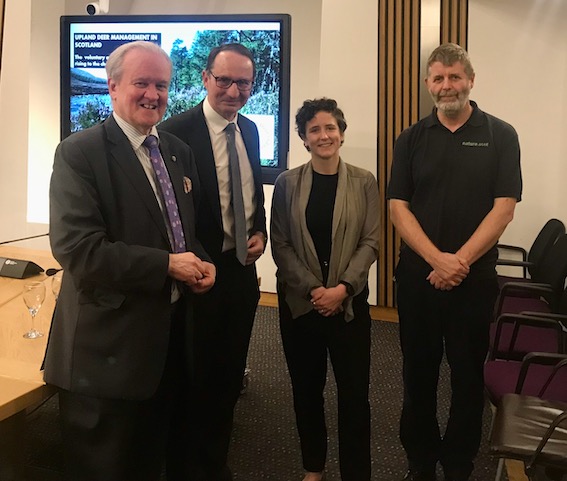
The Association of Deer Management Groups (ADMG) staged an event at the Scottish Parliament on 3 March 2020 hosted by Stewart Stevenson MSP and titled Upland deer management. The voluntary approach: rising to the challenge.
The
event was held following the most recent SNH review
of deer management published in November 2019, and the report of the Scottish
Government appointed Deer Working Group earlier this year. A key objective of
the event was to help to inform MSPs, officials and others about the
significant progress made by Scotland’s upland Deer Management Groups, and the
objectives of ADMG going forward.
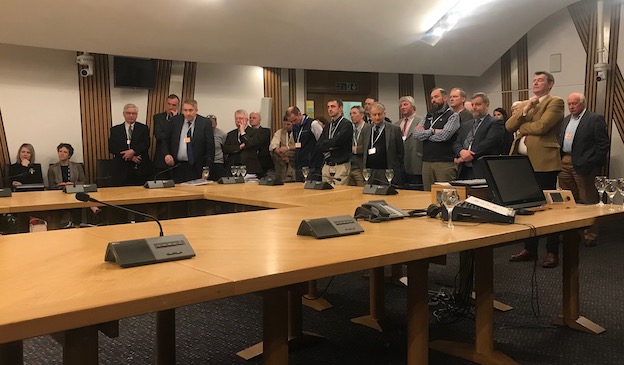
The event was attended by around 50
representatives of the sector including DMGs, SNH, Forestry and Land Scotland,
and other organisations and NGOs including the Woodland Trust (representing
Scottish Environment LINK) involved in upland deer management.
L to R: Stewart Stevenson MSP; Richard Cooke, ADMG; Marie Gougeon, Rural Affairs Minister; Ross Johnston, SNH
Speaking afterwards Richard Cooke,
Chairman, ADMG, said:
“This was exactly the right time to
hold this event given where the upland deer sector is right now in terms of
review, in being alert to the climate emergency announced last year by the
First Minister and in promoting the positives to our membership going forward,
and the measures that they can deliver.
The remit of voluntary deer management in our uplands is changing, and
has changed significantly in the last 20 years, but DMGs are now in most cases
best placed in upland areas to deliver the work on the ground to address the
climate challenge – peatland restoration and woodland planting and regeneration
for example – with many already doing so.
“I am grateful to Marie Gougeon MSP,
Minister for Rural Affairs and the Natural Environment, for taking the time to
come and talk to us, and also to her MSP colleagues who attended for taking an
interest. Thank you also to Stewart
Stevenson for his part in making this important event happen.”
Rural Affairs Minister Mairi Gougeon said:
“There is no doubt that considerable progress has been made in Scotland with deer management plans, habitat assessment, training for recreational stalkers and protection of the public interest generally.
“We are all aware that more remains to be done to ensure that our natural environment is resilient. This event was a good opportunity to discuss the issues we face and how together we can help tackle climate change through nature-based solutions such as tree-planting and peatland restoration.
An attentive audience for the presentations
Ross Johnston, Deputy Director of Sustainable Development, SNH, who also spoke at the event, said that SNH recognised the value from progressive, collaborative approaches to managing deer and the benefits that the best performing DMGs could deliver for people and nature. Also, that SNH recognised the significant efforts made by DMGs in delivering improvements identified through the assessment process and that those SNH staff involved saw this on the whole as a positive and constructive exercise. Looking ahead he said;
“This is happening at a time when approaches to regional land use planning are being developed, post EU exit funding and future agricultural support is being considered, and when natural capital approaches are becoming more advanced. These are all potentially significant in how Scotland’s land and deer are managed in the future. Deer managers should be alert and consider making the case for support for sustainable deer management as future funding schemes are being shaped.”
Richard Cooke, Chairman, The Association of Deer Management Groups, said:
“Many of the recommendations contained in the Deer Working Group (DWG) report published today concern tidying up and updating current legislation, and these are broadly welcome.
“But fundamentally this report is about further heavy reductions in deer numbers which would have a devastating effect on an important rural industry in the remoter parts of Scotland and there is a real danger if we continue to demonise deer that we overlook the multiple other impacts on our environment. Sheep for example, despite heavy reductions, still outnumber deer 2 to 1 across the hills of northern Scotland and share their habitat with deer. Let’s also not forget the significant value of deer as an asset not least in terms of tourism and as a healthy food source.
“We also question repeated calls for a drastic cull when our red deer densities as cited in SNH’s report Assessing progress in deer management published just in November last year are now down to an average of 9.3 per sq km which is already less than the maximum proposed in the Deer Working Group report.
“The DWG report also recommends a much higher level of government intervention which will come at considerable public cost – and a great deal more engagement from SNH than there is at present. Our view is that across the upland deer range the collaborative deer management group (DMG) system under the voluntary principle is proven and working increasingly well. While other management models may be appropriate in other parts of Scotland the DMGs are a vital part of any solution. The latest SNH report to Scottish Government supports this.
“Whilst there is always room for improvement the DMG system is rising to the challenge and delivering against ambitious climate change targets where it has a major role to play, both in terms of peatland restoration and native woodland expansion for example.”
The ADMG paper Rising to the challenge outlining our vision for the future management of wild deer in Scotland’s uplands is available.
An ADMG response to the recently published Scottish Environment LINK proposal Managing deer for climate, communities and conservation.
We support some of the objectives of this document, which are also Scottish Government climate emergency policy objectives. Indeed, most Deer Management Groups (DMGs) are already delivering peatland restoration and woodland expansion on a wide and increasing scale, alongside a steady reduction in the open hill red deer population. Where we may diverge is in the means to that end proposed by LINK which would amount to a halving, at least, in the population of our native red deer. This would not address all the issues identified and would have a major impact on rural employment.
We do not think it has to be a case of trees OR deer; it can be a matter of trees AND deer.
There is a common cause for all interests in working together towards a carbon neutral Scotland. Many LINK organisation members are active participants in Deer Management Groups (DMGs); we have recently recruited a LINK representative to the ADMG Executive Committee and can therefore hopefully look forward to constructive collaboration in future. What is certain is that when it comes to managing red deer, collaboration, within the DMGs, is essential to achieving the best outcomes for all stakeholders, whatever their objectives.
Firstly, the LINK document states that in 2010 “red deer numbers reach an all time high of 400,000” but fails to recognise that the SNH report Assessing progress in deer management (September 2019) cites that the density of deer in 2019 is estimated to be about 9.35 deer km2, or its lowest level for some considerable time.
LINK in its document sets out Ten public benefits of a new approach on which our comments are as follows:
1. More
trees We are very much in favour of more trees and understand the climate and
environmental benefits. The DMGs are
already coordinating projects involving woodland expansion and native woodland
restoration and there is much more to come.
2. Healthier peatlands Here too the DMGs are setting a lead in peatland restoration projects. Most of the 19,000ha of peatlands restored in Scotland to date have been in areas covered by DMGs.
3. More rural jobs It is difficult to follow the logic of a ‘less deer more jobs’ approach. Certainly, many of the full time employed resident deer management roles would be lost if the deer population became insufficient to support deer stalking businesses, which is how much deer management is currently funded. ‘Hunting’ is an important strand of Scotland’s tourism offer, particularly out of season, and supports many downstream jobs. The 2016 PACEC report commissioned by ADMG which is referred to by LINK estimated the employment impact of deer management in Scotland as 2532 jobs in total which equates to 845 FTEs of which 124 were unpaid, ie vocational deer managers. The economic value is £140.8m, much of which benefits remoter areas with little other economic activity. We reject the argument by LINK to the effect that this economic contribution is too little to matter in the context of overall nature-based tourism.
It is disingenuous to claim that NGO
properties generate more economic activity than deer estates. Both NGO and privately-owned estates support
many economic activities, not just deer management. Many NGO jobs are research related, often
with public funding support. This is to
compare apples and pears.
4. Reduced rural inequality The ‘community model’ is already the norm in many parts of the Scottish lowlands particularly where many vocational hunters undertake most of the local deer management at no cost. It is an appropriate approach for the management of territorial deer species such as roe deer but much more difficult for the herding red deer where a coordinated and collaborative approach to a shared resource, based on a deer management plan, as in a DMG, is most effective. In many parts of the Highlands those who have responsibility for deer management ARE the community and the trickle down effect of deer management to local businesses is a key element of the community based economy. There are also many seasonal jobs associated with deer management. It is sometimes said that deer stalking is “exclusive”, an activity for the rich. This is not so. While there is a high end to the stalking market which generates much of the revenue for deer management, there are opportunities across the country for interested individuals to become involved in managing deer locally, at little if any cost. Even accompanied stalking for red deer can be readily accessed for as little as £250 per day.
5. Reduced
need for fencing All herbivores will browse trees and eat seedlings in regenerating woodland
if unprotected. Even if there were no
deer, much stock and rabbit proof fencing, (two thirds of the cost of a full
deer fence), would still be required.
Despite the steep reduction in sheep numbers since the millennium there
are still 600,000 breeding sheep sharing the hill with less than 300,000 red
deer, and hares and rabbits are also plentiful in some areas.
6. Improved deer welfare Living in open habitats does not necessarily imply that deer welfare is compromised. It is true that hill living deer do not reach the size and body weights of woodland deer. Equally, hill breeds of sheep are less productive but much hardier than their enclosed lowland cousins. Both have adapted to their environment and are acclimatised to it. A visit to any venison dealer will generally reveal healthy carcases carrying layers of fat. Like any other animals, including domestic livestock, otherwise healthy animals can suffer privation and sometimes die in exceptional weather conditions. However, the pattern of milder winters experienced as a result of climate change has made such winters rare (2017 was an exception) and generally natural mortalities are negligible for a wild species, <1% of population. In addition, a population culled selectively at rates of over 20% has a high level of general health with few old or sickly animals. The health and welfare of our wild deer herd is generally excellent.
7. Safer
rural roads Numerically the majority of deer/vehicle collisions (DVCs) occur in the
more populated areas of central Scotland, although collision with a red deer is
more likely to have severe consequences.
Research has not indicated a direct linear relationship between deer
numbers and DVCs but it is agreed that they are a real matter of public safety
concern. Other than deer numbers there
are other factors at work which draw deer to roads (eg unfenced woodland,
verges sown out to grass or salting in winter months) or which enclose them on
roads (eg roadside fences with no buffer zone) and thus increase risk. These additional risk factors can be
mitigated at road and woodland design stage.
8. Fewer
ticks This may now be wishful thinking as tick numbers have increased greatly in
Scotland and they are to be found in all environments including city gardens,
having become as endemic as midges. This
is thought to be due to climate factors but there is little doubt that mammals
(including wild deer) and birds are responsible for their distribution out of
the relatively few and small hotspots of past years. It is unlikely that they can now be
eradicated and a reduction in deer numbers would be unlikely to have a
noticeable effect. The focus must now be
on mitigating the risks to human health.
9. A
cut in greenhouse gases
The methane output and CO2 figures from LINK
are new to ADMG and we would like to see the calculations. The extended logic of this argument suggests
that the world would have a better future if all methane/CO2 producing mammals,
cattle in particular, were removed and this is of course a strand in current
thinking, but that is surely too big a matter to just hang on Scottish wild
deer which are understood to be relatively low emitters of methane.
10. A
stronger venison industry
This argument really does not stand up. Of course, a national reduction cull to
halve the red deer herd would increase the supply of venison for as long as it
took to achieve the reduction but this would create a short term glut, probably
leading to a fall in value, followed by a serious shortage for a commodity
where supply is already in decline.
Victor Clements reviews an important recent paper by James Fenton. This will be of interest to those concerned about the natural environment of the Highlands and particularly the balance between moorland, native trees and deer. The paper was published on 9 October 2019.
Victor Clements writes:
James Fenton was an upland ecologist with the National Trust for Scotland, worked extensively on peat bogs in Antarctica, and has for many years questioned the policy priority given by government and its agencies to native woodland over moorland. He advises the Scottish Gamekeepers Association (SGA). Moorland is a common and widespread habitat in Scotland, but it is rare at an international level. Native woodlands are fragmented and often threatened in Scotland, but birch and pine dominated forests are widespread at an international level. So, which is more important in Scotland, the habitat that is rare here, or the habitat that is rare at an international level? If we want both, do we really understand the interactions between them, and will the appropriate balance we might hope to achieve in the future be the same as that we think existed in the past?
Everyone knows that we used to have a lot more native
woodland in Scotland. We hear about the Great Wood of Caledon. We can see pine
stumps buried in peat hags which are evocative and persuasive. There is no
doubt that tree cover in Scotland was once a lot more widespread than it is
today. The comforting narrative surrounding conservation management in Scotland
focuses on centuries of mismanagement and exploitation of our uplands, and the
less deer/ more trees debate is in many ways a proxy for land reform. We tend
to think that a significant change has occurred relatively recently and that we
(or they) are to blame.
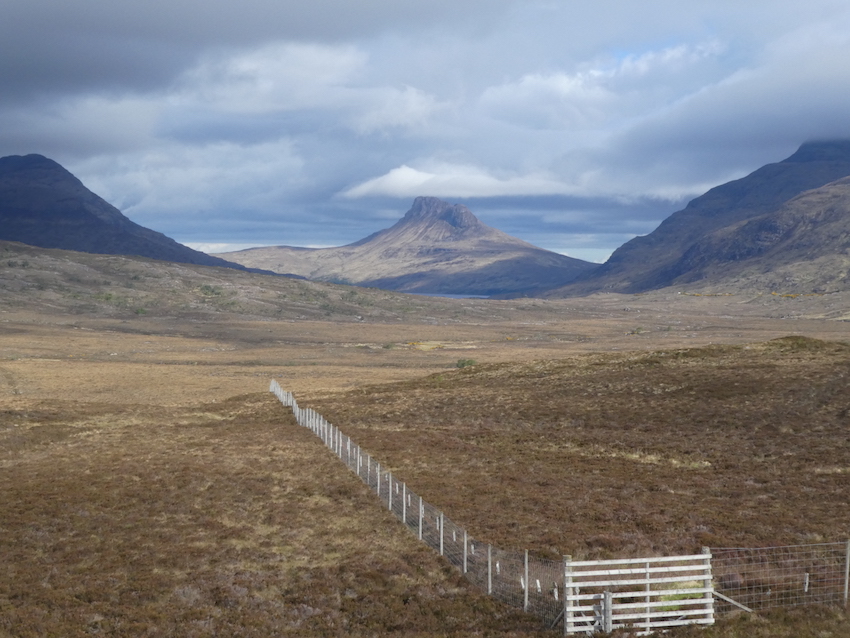
Bog dominated landscapes of the far north
But why did these woodlands decline, when did they decline,
and what should we be trying to achieve now going forwards? James Fenton’s
paper looks at issues from first principles, at biological processes and
experiences from other countries, and asks the reader to have an open mind from
the outset about what our landscape should look like. This is not easy as the
work undertaken by Frank Fraser Darling in his West Highland Survey has
dominated our thinking about the Highlands for seventy years, and government,
agencies, writers and commentators all buy in to this. Scotland’s “wet desert”
is taken as a given truth. It is regarded as unnatural and impoverished, that
we need to open our eyes and accept and then deliver a much more ambitious
vision for the future of our uplands. It takes a very brave individual to
express an alternative view. James Fenton’s paper is such an alternative view,
and we should be prepared to read it with a critical but open mind. As a native
woodland advisor myself, I think there are very credible arguments in here that
are relevant to at least parts of the Highlands, particularly in the west and north
west.
Why did our native woodlands decline? It is now widely accepted that our climate following the last Ice Age was very conducive to tree growth in the Highlands, but a transition to cooler and wetter conditions started to favour the growth of peat over woodlands, and the woodlands started to decline. For those that doubt this, I would ask them to consider the aspen tree. The pollen record suggests that it was a pioneer species after the last Ice Age, often the first species to reach a new location. This suggests it was a species which could seed profusely and spread quickly, but aspen rarely seeds today. There must be something fairly fundamental that is different now. Aspen does seed in Scotland after a drought year, having been stressed by heat or lack of moisture the year before. This tends to happen every 20 years or so (1976, 1996, 2019), but not otherwise. It is likely therefore that our climate now is not just a little bit different from what existed before, but very significantly different. The pine stumps we see covered in several feet of peat confirm that something very detrimental to woodlands happened many thousands of years ago, either gradually or otherwise. Peat could not have accumulated under a live canopy. Man may have over exploited woods, burned them and grazed them, but all this is relatively recent. For most of our recorded history, the Highlands have been relatively open. We may have exacerbated woodland decline in recent centuries, but something much more powerful must have been at work in the thousands of years beforehand. Can our climate really have changed so much, and is this to blame for reducing our woodland cover? Is our future going to look the same as our past, or must our expectations now be different.
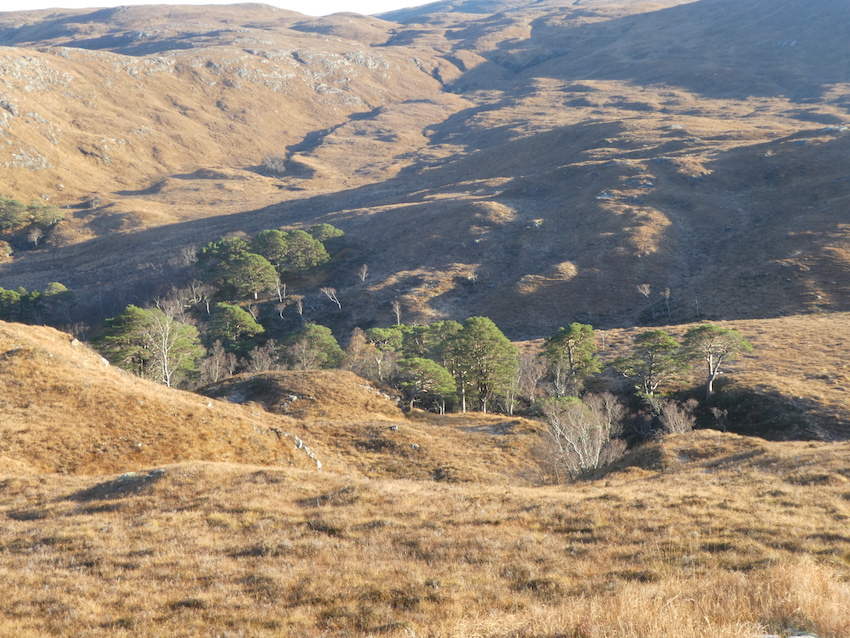
Native woodland surrounded by moorland
First principles James Fenton encourages us to use the Highlands we see today as our starting point, not what might have been the case before, or what we think might have been the case before, and to think about the basics of what might be going on from first principles.
In the summer months, we see a vast over- abundance of
vegetation on our mountains. The theoretical potential carrying capacity of
this might be 70 – 80 deer per hundred hectares if no other herbivores were
present and there was no winter. The winter season of shortage does of course
limit the theoretical population, and other commentators have estimated the
carrying capacity of much of the western Highlands at 16 – 18 deer per hundred
hectares. Management intervention usually limits actual populations to 8 – 10
deer per hundred hectares in the west and north west. While these figures will
vary depending on local conditions, the important point is that our upland
habitats will naturally sustain more animals than the 4 – 8 deer per hundred
hectares commonly cited as being required for native woodland regeneration. I
would say that in many areas, the actual density required would be much lower
than this. So, to get woodland regeneration, we need to fight against what
nature wants to do. Some people will say, “Ah, but the wolves are missing!”
James Fenton will say that our woodland decline primarily took place at a time
when wolves where common and very much part of our upland ecology, very much
before significant human intervention, and how many wolves would be required to
kill the 70,000 red deer that we cull annually today? Wolves are a red herring.
There is a more powerful force at play it seems.
Thick moorland vegetation
At 4 – 8 deer per hundred hectares, 99 per cent of total
vegetation growth is not utilised. This is an unbalanced ecosystem which is
very badly skewed towards this primary production. It is difficult to keep
numbers low when the vegetation is capable of sustaining so many more. This
ungrazed vegetation dies back annually, and adds to the amount of organic
matter in the soil. Acidic conditions slow its breakdown, and it builds up,
increasing the capacity of the soil to hold water. Gradually, peat forms, and
slowly gets deeper. There comes a point where the mineral soils are buried too
deeply for trees to access and to grow. The deer we have today cannot
physically eat enough vegetation to prevent peat from forming. Is this then the
dominant force in our Highland landscapes? In our current climate, are
woodlands really the climax community as we will have been taught, or is
moorland or peatland the likely climax community going forwards? If it is, then
where might we expect trees still to survive?
Where will trees persist? The paper looks at a number of factors that help trees to survive in the presence of grazing animals. If the factors are present, then trees can survive. If they are not, then the balance is tipped towards a more open landscape.
Trees stand a better chance of getting away if they grow
quickly. So, Scots Pine growing on mineral soils at Glen Feshie that can put on
30 cms a year have a better chance of getting established than similar trees
putting on 2 cms a year on wet peatland in Lochaber. The difference can be
profound, but few people articulate this.
Thorny shrubs can allow trees to get away. In the Highlands,
this is usually restricted to gorse bushes at a very localised level, and does
not affect the greater part of the Highland landscape.
In continental climates, snow can cover and protect
seedlings, or prevent herbivores from reaching key areas. This is rarely the
case in Scotland.
Tree morphology can deter browsing. Most of our native
species are palatable to deer, although some less so than others. Spruce trees
are more resilient. Rhododendrons are unpalatable. We see both spreading in
Scotland, sometimes at the expense of our native species. This suggests we may
have to accept these species as part of the mix in the future.
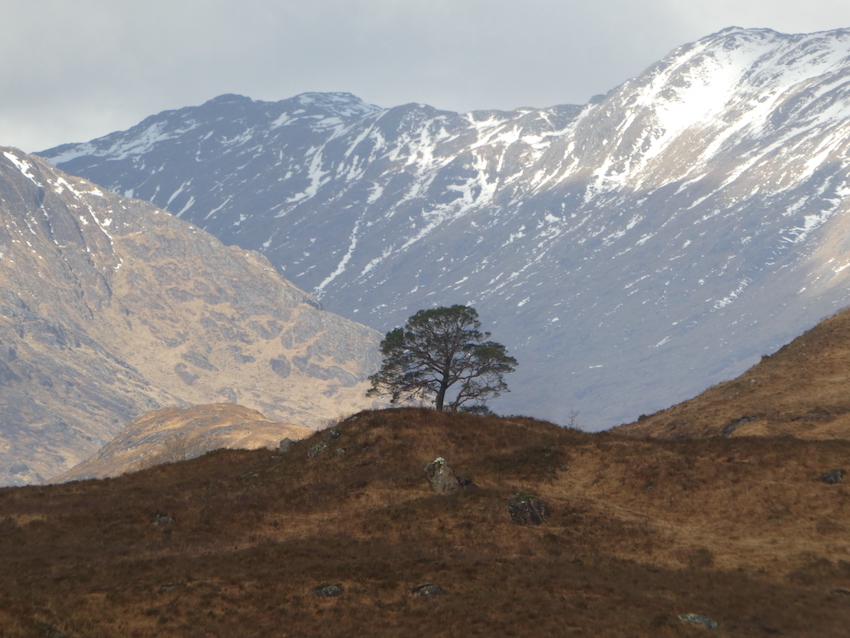
Solitary pine in the landscape
Artificial deer reductions by man can be targeted to help
regeneration schemes, and there are some good examples of this in Scotland.
This replicates the effect of predators on locations favoured by them.
Sometimes, there can be episodic but unplanned reductions in herbivores that
allow trees to get away. For example, disease in rabbits allowed a huge area of
birch and Scots Pine to get away in eastern Scotland in the 1950s. Sheep
reductions in the 2000s have allowed modest woodland expansion in some areas of
the Highlands.
Cliffs and gorges prevent access to trees and allow them to
get away. Such areas also often have better soils as well.
A combination of some or all of the above can certainly
allow trees to survive at a local scale in Scotland.
To get trees away at a more significant level, you do need
to think about the seed supply available, and how susceptible the ground
conditions are. Speed of growth is related to this and very important. There is
no doubt in my mind that if trees have access to mineral soil and can grow
quickly, then they stand a much better chance. Where peat or wet heath
predominates, then everything becomes much more difficult, deer numbers need to
be much lower, and results are always poorer. Podsolization is also much more
likely in such a climate, and this provides another barrier to tree growth that
we usually cannot see. In many areas, you wonder if it is worth it. We are all
aware of native woodlands that are hemmed in by peatland and podsols/iron pans as well and
doing anything with them is very difficult. If it can’t be planted without significant interventions,
it is unlikely to regenerate, but we tend not to articulate this. In this
ongoing battle between trees and bog, so gradual that we can usually only appreciate
it after many years of experience, which is going to win?
It is likely that, over much of western Scotland, it is the
bogs which will dominate in the end, and will ultimately shape our future
landscapes more than deer will, although peat cannot go on getting thicker for
ever, and erosion naturally sets in. A lot of the area is too steep for peat
development and gravity pulls it downhill, although that doesn’t stop us from
trying to ‘restore’ eroded peat on side slopes today. The accumulation
of peat is a much stronger force which even the deer cannot affect. The absence
of earthworms is also key, brought about by decreasing pH. The “wet desert” may
in fact be the natural climax community because it is self- perpetuating and
more resilient in the long run. This was the view of Fraser in 1933
(Fraser, G.K. 1933. Studies of Scottish moorland in relation to tree growth.
Bulletin Forestry Commission, No.15, HMSO), and also of James Geikie in 1866,
but most people today prefer to think like Fraser Darling. Peatland has
a momentum that is difficult to resist. Trees are more sensitive, and require
sustained and more significant interventions to maintain them. If they don’t
get that, they may well go backwards, or be restricted to smaller areas only.
More grass than they need
However, an important part
of James Fenton’s paper is to articulate why woodland died out even on better
slopes without peat bogs and this is where the scenarios for persistence of
woodland in the presence of grazing discussed above becomes important. It is
not only the presence of peat restricting woodland. The other components listed
above affect the ability of native woods to regenerate as well.
-If we want more trees in Scotland, especially if we want to regenerate woodlands by deer control, then we have to be more aware of the dynamics at play, to know where interventions are most likely to be successful, and where the forces against us may be too strong. On many sites, it is possible to return the soils to an earlier post-glacial state by ploughing, mounding and fertilising, but to do that on a particular site, we need to explore why we want trees there, and be sure about what the rationale is.
This is important because
we know that ground preparations can oxidise the organic component of soils
more generally (not just peat), releasing CO2 and actually
contributing to global warming. A better approach may be to allow shallow
podsols to go on and develop peat, this being a better way to mitigate global
warming than planting on them with all the massive interventions that this
would likely require.
If we can start to think in this way, and I suggest that we
should, then James Fenton will have made a very important contribution to the
understanding we have of our natural heritage and what is really going on in
our uplands. Our response to a changing climate going forwards must be informed
by the context of what happened over 10,000 years of changing climate in the
past. More trees in all locations may not be the answer. A large part of our
upland landscapes should always remain open.
Victor Clements is Secretary to the Breadalbane Deer Management Group, is a member of the Executive Committee of ADMG, and works as a woodland advisor, based in Aberfeldy.
The Association of Deer Management Groups (ADMG) says, in the light of the current Scottish Government review of deer management, that its members are meeting future climate change and public interest targets. It has stated in its just published Forward Look that the upland deer sector is “Not part of the problem but part of the solution.”
ADMG says that the latest review of the upland deer sector undertaken by SNH in 2019 recognises significant progress and that, by maintaining that progressive momentum, its members have a vital role to play in the delivery of Scottish Government objectives on climate change, the Scottish Biodiversity Strategy, and real tangible benefits in terms of rural employment and the rural economy, a source of healthy food, and a vital part of Scotland’s burgeoning wildlife tourism industry.
Richard Cooke, Chairman of ADMG, says:
“We have produced our Forward Look because we believe that the 48 DMGs are not just doing a good job under the current system but are leading by example, are demonstrating that collaborative management works, and that they can help to drive change in a fast-changing world.
“Our wild red deer are too often portrayed as the problem, or part of it. We do not see it that way. The population has come down and densities now average less than 10/sq km. Targets for maintaining and creating new native woodland are being met and peatland restoration is being delivered, with much more to come. The DMGs are leading on many initiatives locally to deliver real benefits on the ground.
“There has been a tendency for too long to see the deer sector as
pedestrian, regressive, and obstructive, when all evidence shows that is not
the case. We get the climate emergency
and the part we need to play. We are
delivering on our public responsibilities and will continue to do so.”
Scotland’s
upland deer sector is currently the subject of a review every three years by
Scottish Natural Heritage. These reviews
are based on Deer Management Group (DMG) assessments against some 101 criteria.
ADMG
Chairman, Richard Cooke says, in response to the latest SNH report that has
just been presented to the Scottish Government:
“We
are pleased to note that the SNH 2019 report Assessing Progress in Deer Management clearly recognises significant
progress made by the Deer Management Groups (DMGs) since the 2016 review. For example, 87% of groups have scored more
than 90% in the Benchmark element of the SNH assessment of DMGs, up from 36% in
2016.”
There
are now almost 50 DMGs, covering well over 3 million hectares, more than 40% of
Scotland. DMGs operate mainly in the
management of red deer in the open range and in adjacent woodland and farmland
in the north of the country. Each DMG now
has a deer management plan setting out all land use and environmental
objectives in its area and identifying a target deer population which will meet
the collective land management and environmental objectives of its members. The
grazing and trampling impacts of deer and other herbivores on the habitat are
now monitored by the DMGs with a system of habitat impact assessments (HIAs)
introduced across the open range.
Deer
management plans are reviewed every five years and are available online for
public scrutiny, demonstrating the value of collaboration between neighbouring
land managers and of public transparency.
Richard
Cooke continues:
“The SNH report recognises that, overall, red deer densities are now below 10/sq km and continue to decline due to culling at higher levels than in the past. Around 22% of the red deer population is culled annually.
“The climate emergency is a
matter for us all and DMGs are particularly well placed to make a contribution
to Scottish Government net zero carbon targets by enabling native woodland
restoration and expansion as well as peatland restoration which are now key
elements of Government climate strategy. The SNH report identifies that most
DMGs have recognised where such improvements can be made and many projects are
being implemented.
“To date over 19,000ha of
peatland work has been completed with much more at the planning stage, and much
of the Scottish Biodiversity Strategy target of 10,000ha of new native woodland
by 2020 is being delivered within the DMG areas. We acknowledge however that
there is more to do, particularly in relation to native woodland restoration but we will need more
help from the Scottish Government and its agencies to be able to do this.
“Deer
management will remain in the spotlight over the coming months as we reach the
parliamentary stage of the 2019 review and with the report of the Scottish
Government’s Deer Working Group due shortly.
We welcome that.
“While recognising that many challenges lie ahead the red deer sector has shown that it can respond to changing circumstances and that it recognises its public accountability. As ever, collaboration between all relevant interests is the name of the game and will be even more essential in rising to the challenges of climate change.”
Below
are links to the main SNH report and three associated research reports:
Scotland’s upland Deer Management Groups (DMGs) have now been assessed
for the third time in six years with previous reviews taking place in 2014 and
2016. Some 45 DMGs effectively cover the majority of the red deer range, almost
half of Scotland’s land area, and Scottish Natural Heritage (SNH) has now submitted
its latest review report to Ministers.
Richard Cooke, Chairman of the Association of Deer Management Groups
(ADMG) says that he is hopeful that the considerable progress made by the
Groups will be evident, and that the important part that they play in
safeguarding and promoting Scotland’s natural environment will be recognised.
Richard Cooke says:
“The evidence from the review will we believe show that our sector is at
the forefront of ecological and habitat regeneration, enhancing the landscape,
and managing Scotland’s iconic deer herd sustainably – all a far cry from how,
and too often, we are portrayed.
“We believe that this very detailed examination and analysis, which has now
been presented to Government, provides clear evidence of progress, both at
national and local levels. The SNH Assessment system is now well established
and is a robust means of monitoring the effectiveness of deer management.
“Clearly the timescales over which environmental change can be brought about may be decades, but that process is well underway. In terms of deer densities, the report produced by the James Hutton Institute for SNH in 2017 based on SNH count data showed that, after a period of population growth, overall densities of deer on the open hill had been relatively stable since 2000 at an overall average of around 10 deer/km2 and are now declining due to culling pressure. This despite falling sheep numbers and more favourable climatic conditions leading to higher levels of recruitment.”
Richard Cooke asserts that the voluntary principle and collaboration are
at the heart of progress being made and that through joint working even the
smallest changes can make significant differences on a landscape scale. He says:
“It is clear that land managers have embraced the need to look forward
and are responding to fast changing national priorities. This is evidenced in the evolution and
implementation of deer management plans that cover over 3 million hectares of
the uplands and address a whole range of important factors such as habitat
impact assessment, woodland expansion, peatland restoration, and delivering
demonstrable public benefit, including a major contribution to the Scottish
Government’s climate change agenda. We
need to build on this to ensure that this considerable private and public
investment continues to contribute in these areas, supports our fragile rural
economy – and is recognised for doing so.”
“We await a response to the SNH report from the Cabinet Secretary, and
thereafter discussion at the Environment, Climate Change and Land Reform
Committee. We also await the findings of the Government appointed Deer Working
Group which is due to report on the system of deer management in Scotland next
month. What I do believe however is that
the 2019 assessment will demonstrate considerable progress and responsiveness
to the findings of previous reviews. The
sector has shown that it can rise to the challenge, adapt to a fast-changing
world and new priorities such as the climate emergency. There is, we acknowledge, much more to do and
the red deer sector will play its part.”
ADMG had a successful few days at Scone with useful meetings and contacts made, and it was good to welcome so many onto our stand. Our congratulations to Balmoral Estate for their success in the Fred Taylor Memorial Trophy and who have supported this event from its first year. ADMG established the trophy with the Game & Wildlife Conservation Trust seven years ago in memory of head stalker on the Invermark Estate, Fred Taylor, who was a great Highland pony enthusiast. Generously sponsored again by London gunmaker John Rigby & Co, the winning estate receives an engraved Highland Stalker rifle, as well as a Bronze Medal from the Highland Pony Society and, by tradition, a bottle of Whyte and Mackay which was Fred Taylor’s chosen tipple.
Harmony, with ghillie Rebecca Cantwell were the winning team this year from a splendid turnout in the main ring, judged by Richard Fraser of Atholl Estates. Without doubt this event has become one of the highlights of the Fair. A big thank you from ADMG and GWCT to all those who took part – some, again, travelling considerable distance to be there.
The top placings this year were Kimberley Watson, Balmoral, 4th; Ali Beveridge, Glen Prosen, 3rd; Steven Macdonald, Meggernie, 2nd; and Rebecca Cantwell with Balmoral Harmony, 1st.
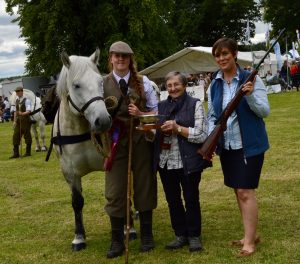
Pictured, Harmony with Rebecca, Anne Taylor, widow of Fred Taylor, and Liz Brodie, John Rigby & Co.
A project undertaken by the Moredun Research Institute and the University of Edinburgh into harmful E. coli O157 bacteria in Scotland’s wild deer has established that the bacteria has a low prevalence in deer of less than 0.3 per cent.
Richard Cooke, Chairman, ADMG, says:
“When we signed up to the project it was in part a leap of faith and we hoped that science would show that the occurrence of this bug in our wild deer species is extremely low, and this has turned out to be the case. Whilst we cannot make comparisons with the level in livestock or other foods, or comment on the level of risk to human health, we can certainly take comfort from this result whilst at the same time encouraging all involved in the sector to continue to be vigilant and observe Best Practice at all times to keep incidence to an absolute minimum.”
The study, funded by the Scottish Government and Food Standards Scotland, was carried out following the outbreak of E. coli O157 infection in people linked to the consumption of venison products in 2015. The bacteria, which is shed in animal faeces, causes disease due to the production of Shiga toxin and is most severe in very young or elderly people. The research set out to determine what the levels of E. coli O157 in wild deer in Scotland are and how these bacteria might be transferred to meat during the production of venison.
The research was based on the collection and testing of faecal samples from all species of wild deer in Scotland (red, roe, sika and fallow) and covered all of Scotland’s regions where wild deer are present. Through working alongside the Association of Deer Management Groups and Forest Enterprise Scotland, a total of 1087 samples were received of which E. coli O157 was found to be present in three. Two positive samples came from red deer and one from a sika deer.
Despite these low numbers, deer managers and processors are being urged to continue to do everything within their control, from the point of cull to the end product reaching the consumer, to minimise the risk of faecal contamination of the carcass.
Dr Tom McNeilly, the Moredun Research Institute, who led the study, says:
“This project established that prevalence of E. coli O157 in Scottish wild deer is low and suggests that deer are not a major reservoir of the bacteria. Nevertheless, as E. coli O157 was found in a small number of deer and the gene for the toxin was present in a number of other samples, care should be taken to ensure minimum contamination of the deer carcass during processing. We would like to thank the deer industry and Forest Enterprise Scotland who have been fantastically supportive of the project.”
Dr Jacqui McElhiney, Head of Food Protection, Science and Surveillance at Food Standards Scotland said:
“We commissioned this piece of work alongside the Scottish Government in response to the 2015 E. coli O157 outbreak in order to improve our understanding of the risks of contamination of venison meat in Scotland. The results of this part of the survey show that the levels in deer faeces are low, but when E. coli O157 is found, it has the potential to cause severe disease if it is transferred onto the meat. The findings will support guidance that will help producers to prevent contamination.
“We would also like to remind consumers to ensure their venison is cooked thoroughly and that they follow good hygiene practices when handling raw meat to avoid the risks of food poisoning”.
Bill Bewsher, Chairman, the Scottish Venison Partnership, says:
“This has been an important piece of work for Scotland’s venison sector, given the new strategy for Scottish venison launched by Government in September and its increasing popularity.
“We will continue to urge those who manage deer, and those who process venison, to take all necessary steps to ensure that the processed product reaches the market in the safest possible condition, with a reminder to consumers that proper cooking will eliminate any residual risk.”
Notes:
Partners in the Scottish Deer Health Survey include:
Association of Deer Management Groups
Lowland Deer Network Scotland
Scottish Venison Partnership
Scottish Quality Wild Venison
• E. coli bacteria are very common in the environment, with many types of E. coli living in the guts of mammals. Some types of E. coli can cause disease, some are harmless and can even be beneficial.
• E. coli O157 are a particular type of E. coli that can cause human disease as a result of the Shiga toxins they produce during infection. Other types of E. coli other than E. coli O157 can also produce the toxin and can also cause human disease.
• Human infections can cause serious illness or even death, particularly in very young or elderly people.
• E. coli O157 can be carried by cattle and other ruminants, including deer and sheep, without affecting them in any way. Shedding of the bacteria from ruminants tends to be sporadic, meaning an animal that is positive for E. coli O157 on any particular day can be negative on another day.