
Victor Clements
Introduction
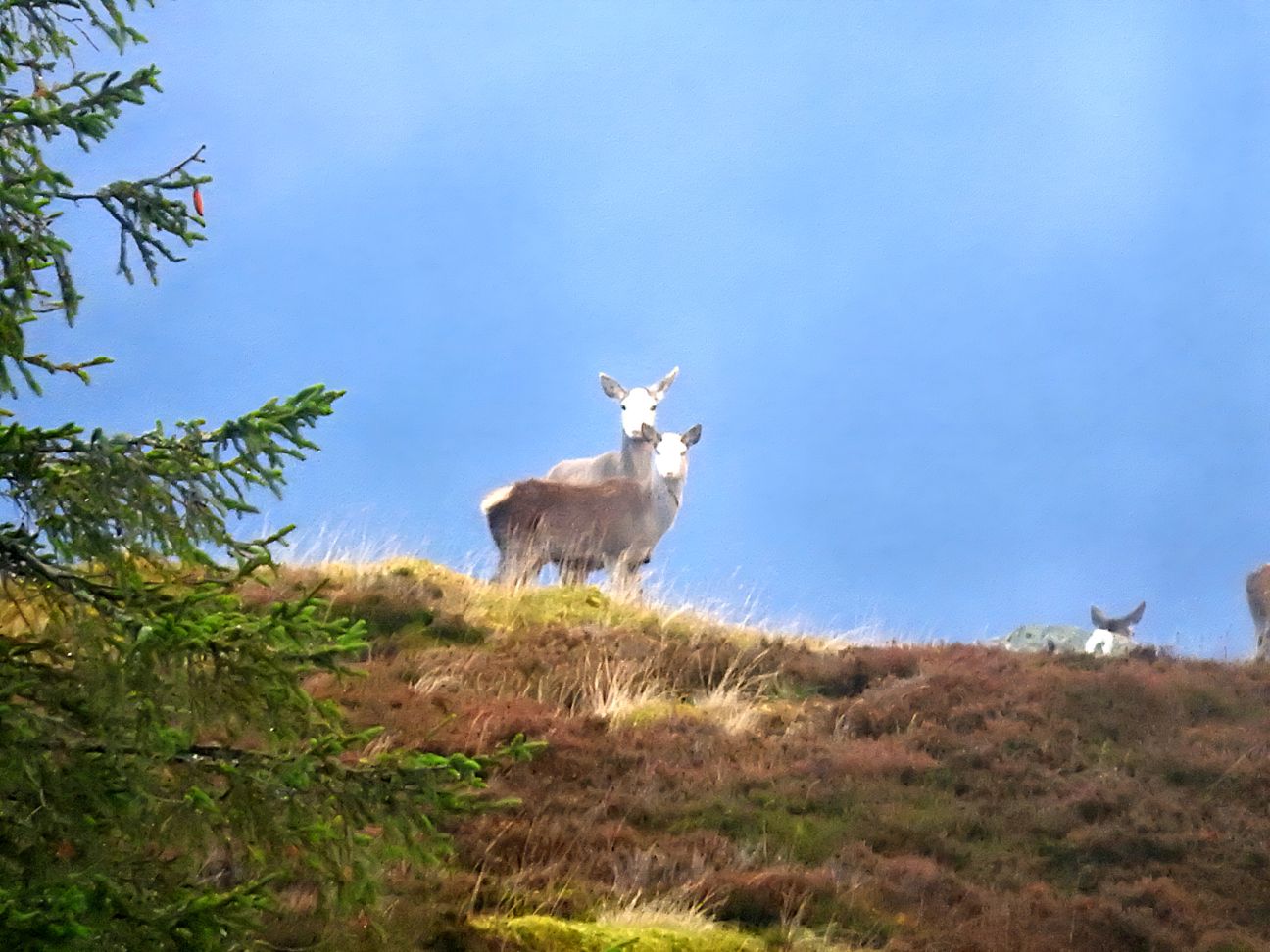
In spring 1976, Heiner Hatlapa was driving north through England, heading for the Scottish Highlands. He was a man on a mission. He had come across from Germany to try and source a bald or white faced/ blaze red deer for his wildlife park at Eekholt at Schleswig- Holstein near Hamburg. He had been to Woburn and a number of other English deer parks to look at their animals and their detailed records, but none of his leads had come to anything. It seemed that the last recorded animal south of the border had been killed by a falling branch in a lightning storm in 1963.
However, it appeared that the animals were still in evidence on the Remony Estate on the south shore of Loch Tay in Perthshire, near to the village of Kenmore. This was his destination now, and with him he had a horse trailer, nets, a tranquilizer gun and other fishing equipment. He was working with G Kenneth Whitehead, who had made the introduction with Remony, and deer vet and farmer John Fletcher was to try and dart an animal.
Once there, three days were spent searching a large area trying to locate and capture one of the animals, but without success. Getting within 20 – 30 metres to dart a deer in that type of landscape was more or less impossible. On the last day, the Remony head keeper Angus Hogg suggested that the most practical way of securing a white faced deer would be to try and catch a calf shortly after it was born. He had experience of doing this for a range of other projects and research studies.
Reassured that this was the best way forward, Heiner then returned to Germany, and had more or less forgotten about it when, in June, he received a telegram which said very simply “we got it.”
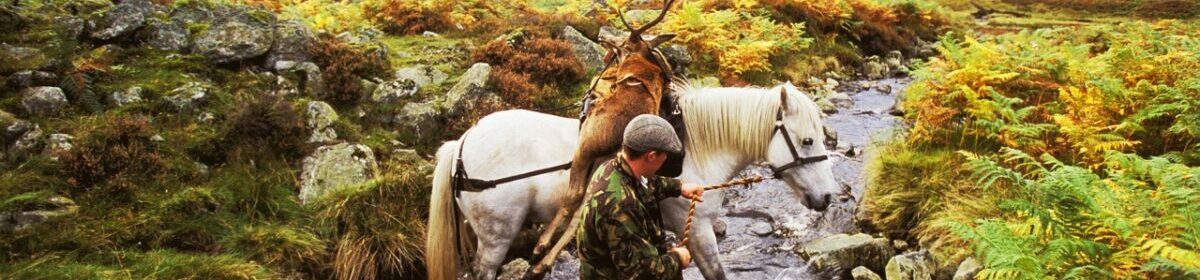
Angus had been sitting out looking for foxes with his under keeper Nick Boulton. It was peak calving season, and he noticed a hind moving to a hidden calf. When the calf got up, he briefly caught sight of what he thought was a white face. They waited until the hind had moved away again, before moving to the place where the calf was hiding. The hind was a normal colour. The calf was quickly caught and was exactly what they were looking for, a white faced stag calf, maybe just a few hours old. A dog lead was fixed around its neck to secure it. It was part carried and part walked a mile back to the Landrover, taking to the two men straight away. Its navel was dry, and it had obviously suckled, so it was perfect for lifting. It was kept for six weeks or so until it was big enough to be transported in a box back to Germany, and this gave time for the various permissions etc to be given at that time. Nick Boulton, now living in Australia, remembers feeding the calf. Angus Hogg remembers it residing in his potato patch, and always immediately coming to him as he approached. It was now completely imprinted on to its new family. Angus now lives in Aberfeldy with his wife, and both remember the story very well.
Moving forward to the present day
In 2025, Ben Harrower of BH Wildlife Consultancy was conducting a landscape scale drone count of the area which included the Eekholt Park, and he came across a group of these bald faced deer.
What were these animals? Where did they come from, where are they today and what significance or relevance, if any, do they have?
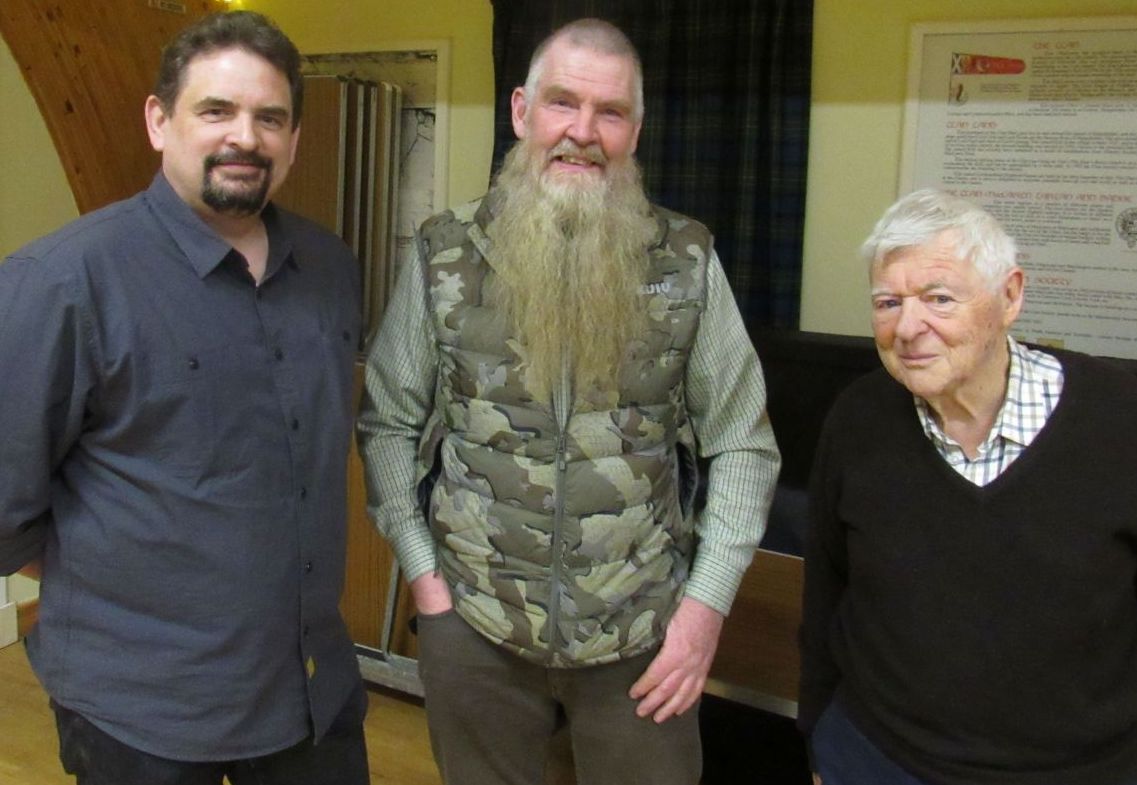
Ben volunteered to ‘join the dots’ and the result was a series of presentations in the Balquhidder village hall on 2April 2026, the 50th anniversary of Heiner Hatlapa going to Remony. The evening was organised by the Balquhidder Deer Management Group, with around 40 people attending. Some were deer stalkers, but many were simply local residents and hill walkers who knew about the animals. The presentations were made by Dr John Fletcher, well known deer vet and deer farmer from Reediehill, Fife, Walter Mahnert who is the grandson-in-law of Heiner Hatlapa and current owner/manager of the Eekholt Park, and Donnie Broad, manager of Pitcastle and Glenlochay Estates in Highland Perthshire.
The purpose of this article is to try and build on the meeting and discussions which took place, to try and raise the profile of the animals, and to try and elicit some further feedback on their current distribution.
Looking at these animals from both a Scottish, English and German perspective is very instructive, with each of these countries having their own partial understanding of what these animals are and where they came from. ‘Joining the dots’ is a good term to use.
This is not a scientific article, and a detailed understanding of the genetics is beyond the ability of this author. The attempt being made here is to try and tell the story and prompt curiosity and interest in others.
The English Perspective
There are a significant number of inns and pubs in England called ‘The Bald faced Stag’, or variations of that, over and above the many called ‘The White Hart’. So, these animals have obviously been a feature in local culture in several areas for a long time, most likely for many centuries (for the avoidance of doubt, bald faced deer and white deer are completely different things. One is not just simply a variation of the other).
On 27February 1800, a satirical cartoon was published in the press by SW Fores of Piccadilly. The cartoon can be found in:
George, M Dorothy (1870–1954). Catalogue of Political and Personal Satires Preserved in the Department of Prints and Drawings in the British Museum.
London: The British Museum.
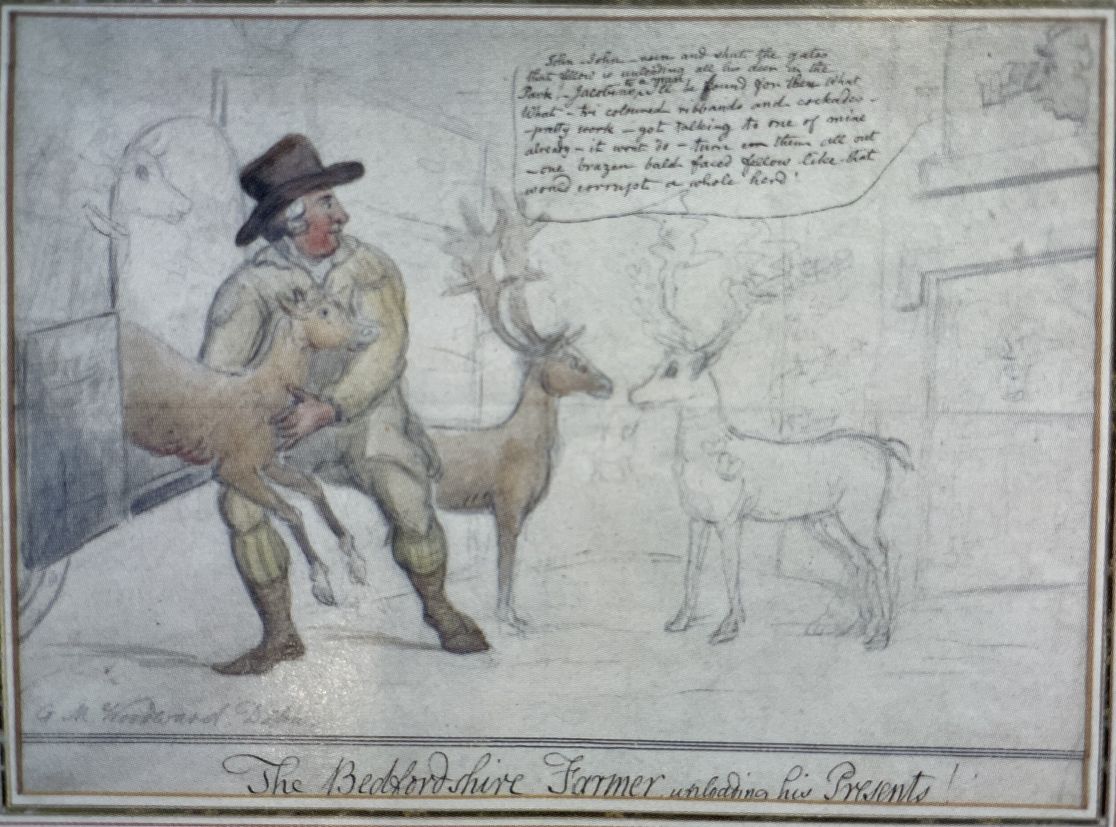
The cartoon shows the Duke of Bedford unloading some deer into one of the Royal parks. The King, watching from a window, is not impressed, with anxiety clearly rising in him. The speech bubble says:
“John – John – run & Shut the Gates –that fellow is unloading all his deer in the Park! Jacobins to a man I’ll be bound for them. What – Tri-coloured ribbands and Cockades – Pretty Work – Got talking to one of mine already – it won’t do – turn them all out- one brazen Bald-faced fellow like that would Corrupt a whole Herd!!”
The cartoon, on the surface, is about deer, but of course refers to something else entirely. This is the year 1800, over 50 years since the Jacobites were defeated at Culloden, but the threat of them re-emerging in some form was obviously still there, and of course, there was the situation at that time in France as well, more than enough to make any monarch concerned, especially if the two decided to join forces. This would have been the primary concern. The King is equating white faced or bald faced deer with a Jacobite or republican threat to undermine him. The Duke of Bedford at this time was the 6th Duke, Lord John Russell, the Lord Lieutenant of Ireland, and a firm supporter of Bonapartism. In 1803, he married Lady Georgiana, daughter of the Duke of Gordon, who allegedly had a long affair with Sir Edward Landseer, painter of the Monarch of the Glen.
This idea that the bald faced deer might somehow corrupt the ‘normal’ red deer is still very much in evidence today. In Germany, there are none outwith deer parks, and possibly not for the last century. It is not certain how hunters would view them today. Some would cherish these kind of anomalies, but others are likely to be suspicious of them. They are not an animal that they wish to encourage, and they may pro-actively remove them from the population. In Scotland, many stalkers view the heads of bald faced stags as being inferior to other animals, and the bald faced animals are suspected as not being as winter hardy as the general red deer population, an observation supported by Alan Sneddon. Angus Hogg says that in all his time at Remony, he had only ever seen one good white faced stag with more than six points, with the majority of them never developing very well. They tended to be smaller and therefore did not breed as well as others. This idea that they might introduce traits that are detrimental to the species is therefore both current and historical. It is highly unlikely that there is any actual scientific evidence of this, but those familiar with the animals regard them as not being as good as others, but something that visitors can be fascinated with. It is only for this reason that they value them and avoid culling them. They tend not to match up in other ways. We will pick this up again later in the article.
That the King associated the bald faced deer with Jacobite traits could potentially be read to imply that the animals were present in Scotland prior to 1800, but there is nothing to document this further.
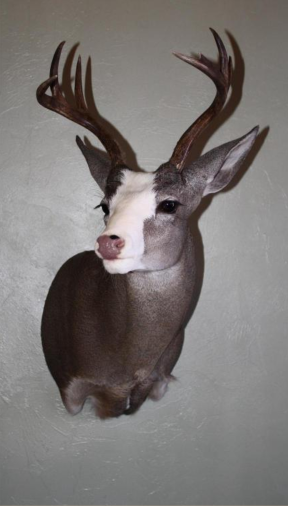
In his book, Some account of English deer parks (1867), EP Shirley mentions the bald faced colouration in fallow deer originating from Bosworth Park in Leicestershire, so it appears that this is something which does not only occur in red deer. Below is a picture of a blaze white tailed deer, so other countries have this phenomenon as well, across a range of deer species.
The Scottish Perspective
There is little mention of bald faced deer in Scotland before the late 1800s, despite the implication from the satirical cartoon in 1800 that there might be a strong Scottish connection.
The accepted narrative now is that they first came to Scotland as a present from the King of Denmark to the Marquis of Breadalbane around 1880.
‘The King of Denmark gave the late Marquis of Breadalbane some partial albinos. They were turned out at Taymouth and their only descendants left are two bald-faced hinds which live in the sanctuary at Blackmount where I have seen them on several occasions’ from British Deer and their Horns, J G Millais 1897
I read this to imply that the white faced deer were no longer at Taymouth by 1897 but see below.
The G Kenneth Whitehead Encyclopaedia of Deer (1993) reinforces this, with the extra detail that this importation was in the later part of the 1800s, and that the imported animals were hinds. Some were moved to Blackmount, probably the source of a bald faced stag shot by a poacher on Achnacarry deer forest in 1890. This account also suggests that bald faced deer were introduced to Drummond Hill, adjacent to Taymouth Castle in 1880 too. During WW1 however, timber operations there allowed them to escape, and it is held that these animals may be the ancestors of those that occur in Perthshire today. Others question if there were deer released on Drummond Hill if forestry was the main land use there.
Bald faced deer had been imported to Woburn about the same time, with occasional animals given as presents to other deer parks in England. However, as we have seen, these animals gradually dwindled away to the point that there were none left by 1963.
At Taymouth, it is reported that the last bald faced deer to be enclosed were at the White Tower on Bolfracks Estate, and that these animals escaped through either forestry operations or trees being blown across fences according to Donnie Broad.
Angus Hogg relates that when the white faced deer escaped from Taymouth (he was not exactly sure when or from where), half of them went north, and half of them went south. The ones that went north were more of less shot out, not least because of a need to protect trees on Drummond Hill, but the estates there tended to shoot them as well. The ones that went south were treated differently, with stalkers tending to leave them alone. The population in South Perthshire therefore grew, and this is the centre of their population today, with Remony still being the main property holding them. To the north, they are much more of an occasional sighting.
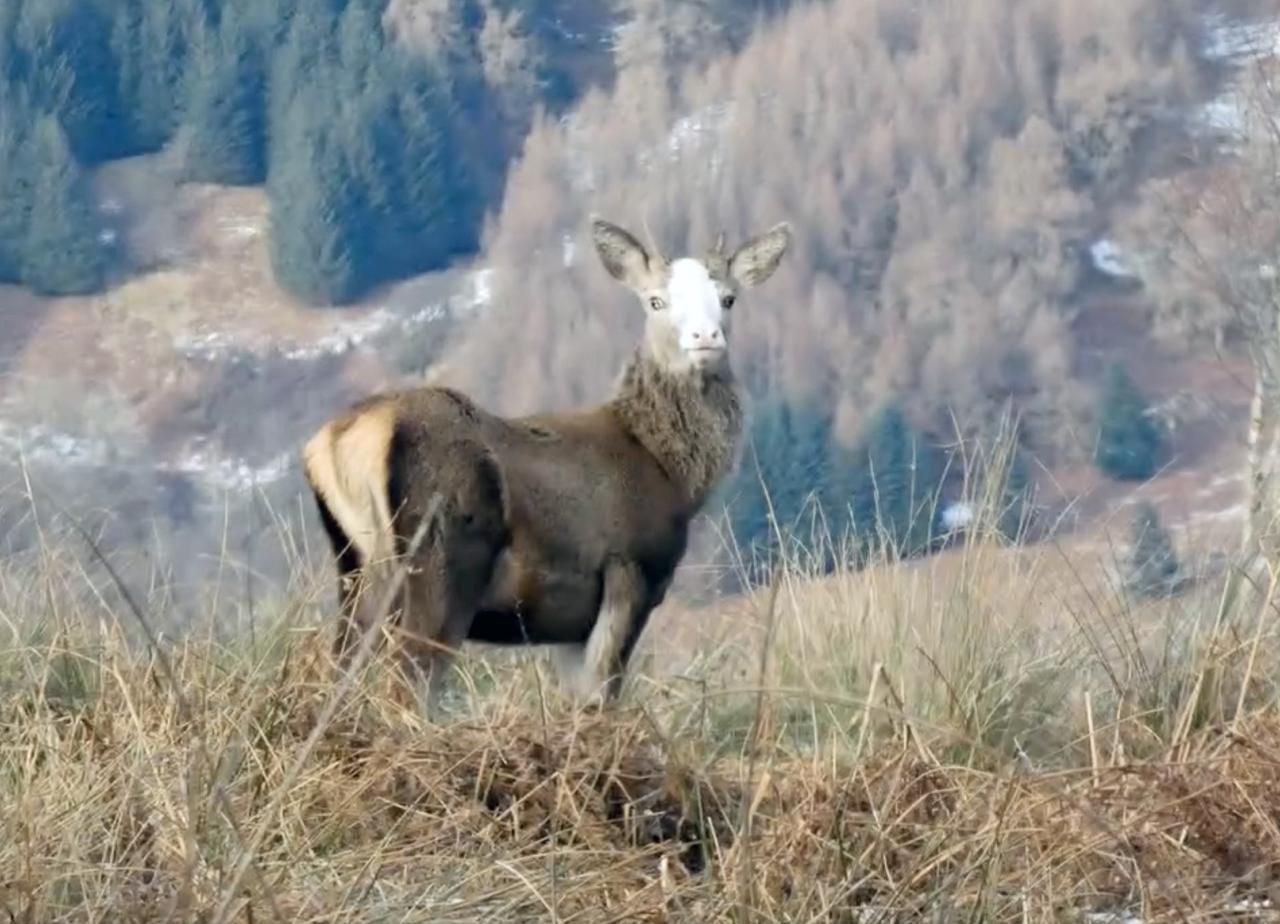
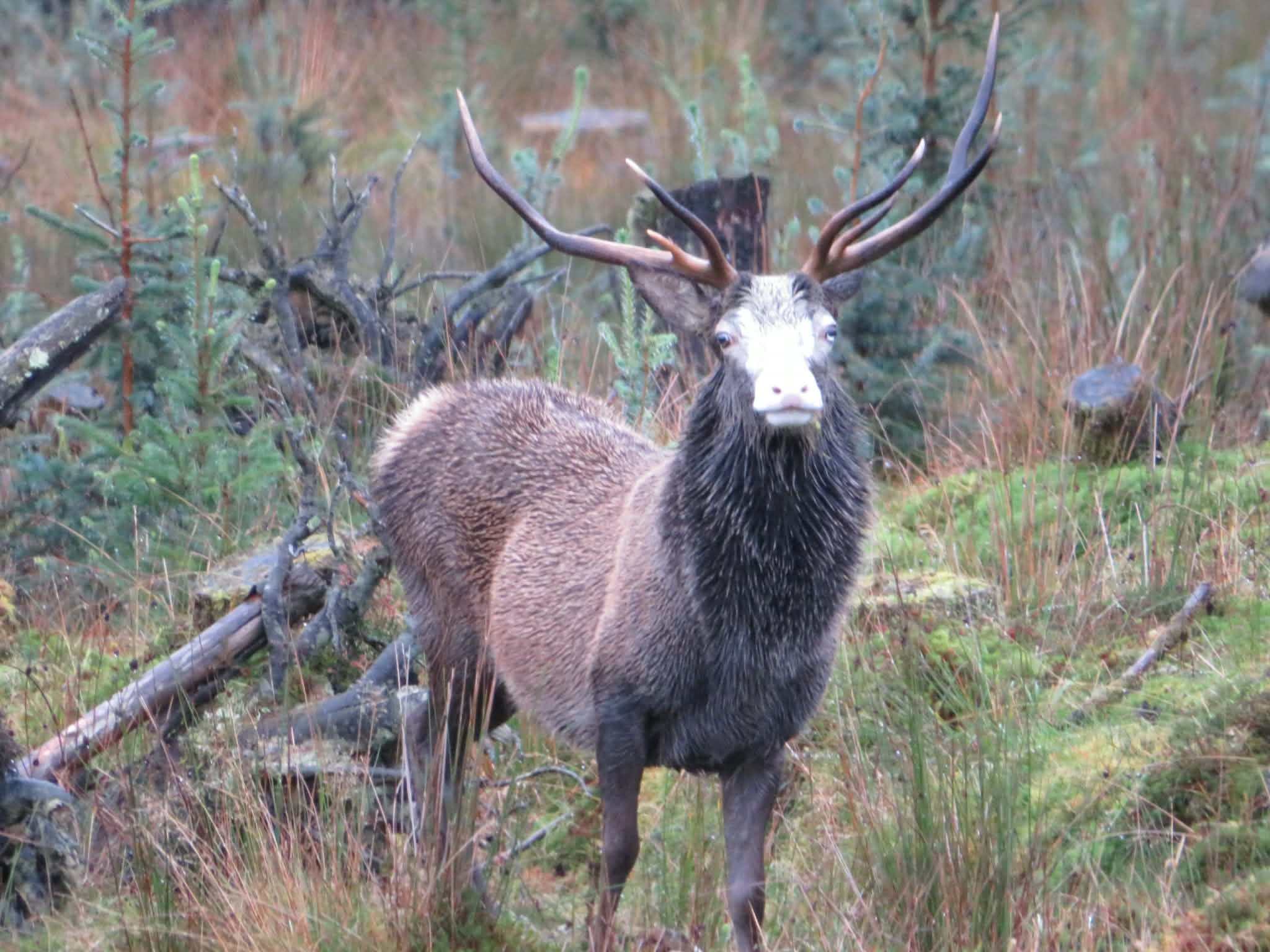
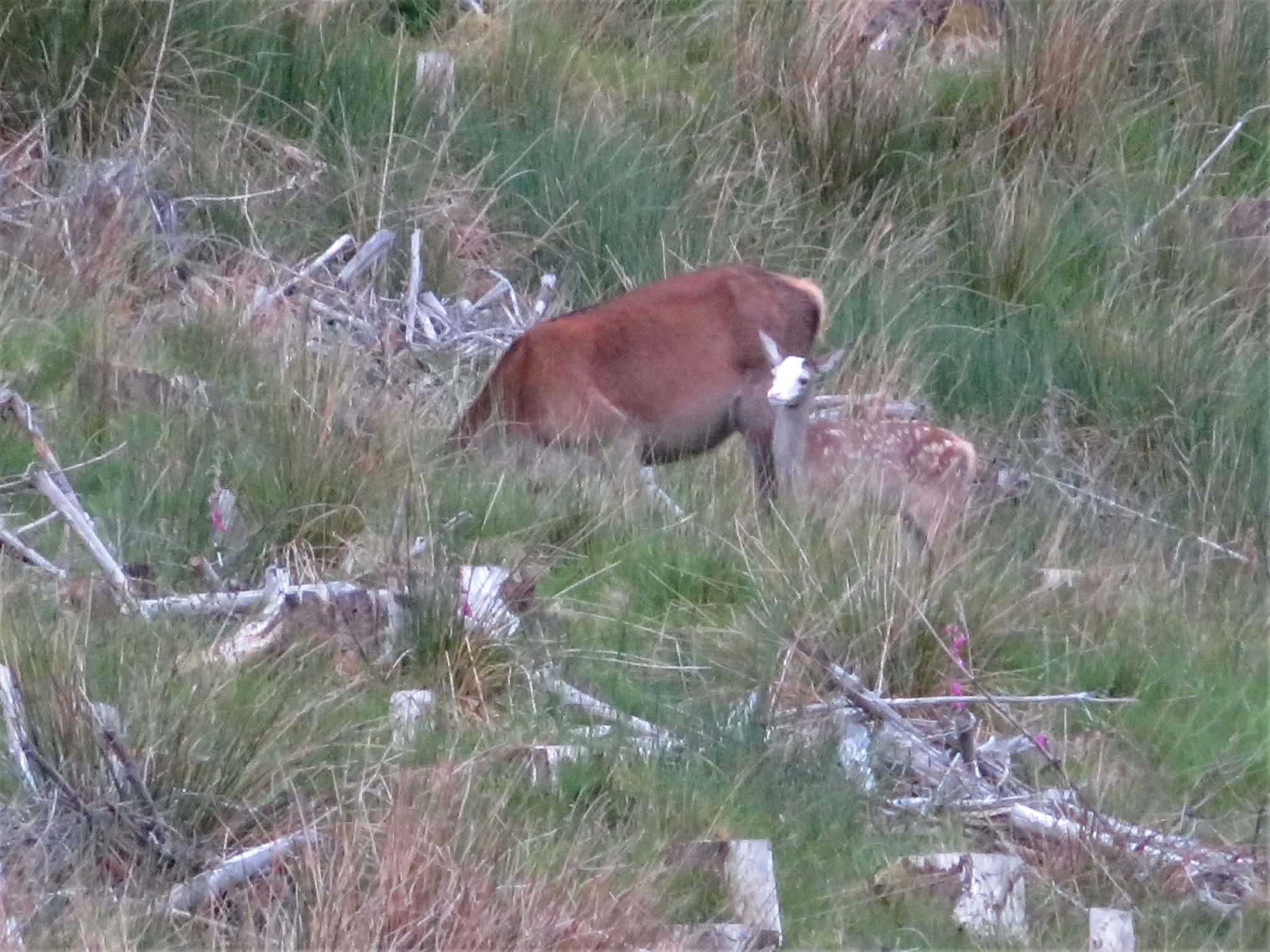
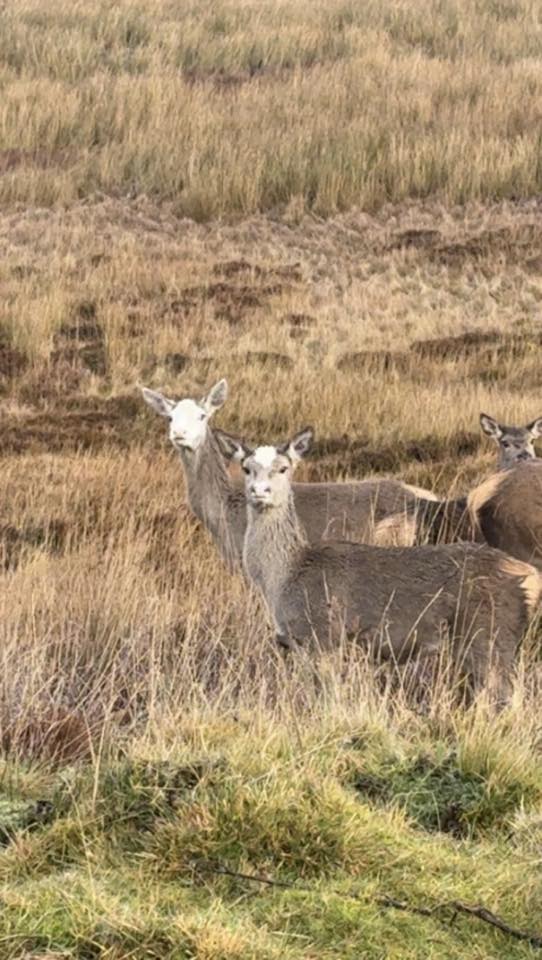
It is interesting then that these animals in English deer parks dwindled away over time, but once the genes got out into the wild population in Perthshire, a number of animals have been maintained within the population through to the current day. They exist within a seemingly restricted geographical area, extending from lower Glen Lyon into South Perthshire and on into Balquhidder. Their numbers are small, uncommon but not rare as such. They seem to be able to maintain themselves, and there is no suggestion that the population is reducing. They are regarded as being peculiar to this area, with few reported beyond, although it is reported that a bald faced animal was culled on the Cowal peninsula in recent years. Perhaps the genes survive at a lower level elsewhere as well, and occasional animals arise from this.
In terms of numbers, the recent event in Balquhidder resulted in a significant number of photographs coming in, clearly showing different animals in different locations. We cannot tell too much from this, but it would seem that there must be at least several tens of animals in the wild, possibly 20 – 70, something like that. It is highly unlikely there are more than 100+. We cannot say of course how many animals might actually carry the genes. Angus Hogg thinks there might be 30 – 50 in the wild.
The German perspective
Heiner Hatlapa came back to Remony in summer 1976, having arranged the necessary permissions to transport his young bald faced red deer stag calf back to Eekholt. Since it was caught, the calf was bottle fed by Nick Boulton, who worked under head keeper Angus Hogg at Remony.
The young calf was called Bless. He survived the journey and did well at his new home, being hand reared. He grew into a fine stag and when he was old enough he was put out with a small number of ‘normal’ red deer hinds. The resulting animals were carefully managed to avoid inbreeding, crossed with other red deer. The genes survived, more bald faced deer were born into the park, and over the decades, their numbers increased within a larger group of animals. These are the animals that Ben Harrower found in 2025.
Being hand reared, Bless became a problem stag, damaged property and equipment, and was a danger to park staff at rutting time, for which his antlers had to be removed. An injury to a warden eventually resulted in his sale to a property in Spain, where he stopped a bullet, and was no more. But he left his mark at Eekholt, as evidenced by the animals now present there. The white genes therefore came from Remony, which appear to have come from the King of Denmark via escapees from Taymouth Castle.
Walter Mahnert, grandson-in-law of Heiner Hatlapa, understands the European history very well.
It is considered that between 1795 and 1828, there were bald faced deer present on at least six deer parks in Germany, and possibly more than this, and had obviously been there for a considerable period of time. There is a handbook for hunters in Germany from 1868 which lists the colour variants in deer as “red, silver, white and bald faced”. So, these animals were known in hunting education at the time and may well have been widespread in their distribution.
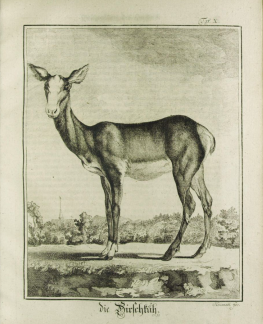
In 1765, a young Friedrich Leopold, Count of Stolberg, moved with his mother and brother to Denmark, north of Copenhagen. He was married in 1790, and it was thought that at this point, he was presented with his first bald faced stags by Crown Prince Frederick VI of Denmark and Norway, and Duke of Schleswig- Holstein. This confirms the animals now in Denmark.
It was from here that the King of Denmark gifted some bald faced deer to Gavin Campbell, 1st Marquess of Breadalbane, in the late 1800s. Shortly after, they also sent bald faced deer to Woburn.
Walter’s account suggests that there was a further movement of bald faced hinds from Denmark to Blackmount in 1897 and released into a sanctuary there, which was after the poaching incident at Achnacarry in 1890. So, either that animal managed to escape from and then move from Taymouth, or such animals were already present in the west, albeit only arising very occasionally. The other possibility is that when the hinds were imported from Denmark in 1880, they were split between the various Breadalbane Estate deer parks, and not all just released at Taymouth Castle. Donnie Broad thinks this is possible, even likely. We don’t know how many animals were actually gifted.
Today in Germany, these deer are only really present within parks, and there are occasional movements between them. Outside these parks, some hunters view them with suspicion, but others are more curious. We see this mix in Scotland too.
Taymouth
All the evidence we have suggests that the bald faced deer now present in Breadalbane and South Perthshire arose from Taymouth Castle, having arrived there from Denmark in the late 1800s. It is possible that they were contained for less than 30 years, maybe not even that. Certainly, by 1922 when the Breadalbane Estate broke up, there would have been no-one to maintain the deer parks, and if some had not already got out into the wider area, they would have got out then. One of the constituent new estates, Bolfracks, may well have kept some bald faced deer enclosed for longer, but they might well have been living in the wild anyway before they finally managed to escape. In Scotland, our record at keeping animals enclosed and out of the wild is not good.
There is a long history of deer parks at Taymouth and the Breadalbane Estates in general. Sir Duncan Campbell of Glenorchy established parks at Balloch (Taymouth), Glenloquhay (Glen Lochay) and Glenurquhay (Glenorchy) in 1613/14, and potentially long before that as well. The introduction of fallow deer is specifically mentioned. Some people credit Sir Duncan Campbell with introducing fallow to Scotland, but others disagree with this. Extensive Scots pine and birch woods were planted around these parks. Drummond Hill above Kenmore indeed is regarded as being the first plantation woodland in Scotland, with estate workers establishing and tending young trees for production and amenity for the first time.
So, the Breadalbane Estates are likely to have had multiple numbers of deer parks in different locations as already suggested, not just the very extensive ones at Balloch (Taymouth Castle), although these are likely to have been the most impressive.
The following image shows an extract of an estate map from 1784, with the enclosed deer being clearly visible in the grounds of the castle. This is long before golf and bald faced deer. The deer would have been kept in by an elaborate system of ditches and embankments (ha-has), sometimes with a 6 ft fence barrier erected as well where required. At the time, this would have potentially been the most impressive deer park in the Highlands.
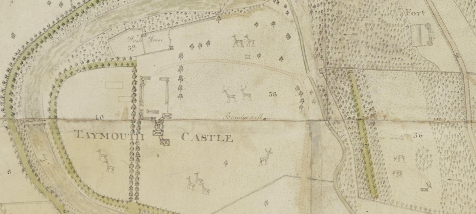
When the bald faced deer were gifted by the King of Denmark around 1880, we assume they were released here. Whether it was possible to keep them by themselves separated from others, or whether they just became added to the wider herd cannot be known. Likewise, other parks were available to the Marquis, each of which was locally important as well. So, it is possible that the bald faced deer were distributed between several parks, and not simply kept all together at Taymouth. There is no way of knowing this unless some additional documentation from the time becomes available. It is also not known how many deer were gifted. Perhaps there were only a few, in which case, they would have been more likely kept together.
Whatever the case, it is now accepted that Taymouth Castle was crucial to the establishment of these animals in the wild in South Perthshire and Breadalbane, and that the known current Scottish population came from there. There do not appear to be any records elsewhere in Scotland*, although you do hear of white deer more generally. Further west, they are remarkably less frequent, with just very occasional sightings. If there are records from further west, it would be good to know more.
*Initial feedback to this story suggests that bald faced calves have been caught and tagged at Mar Lodge in recent decades.
Bald faced red deer – so what?
The status of this animal is peculiar in many ways. We have seen that in Germany there is a mixture of curiosity and possibly suspicion, and the white colouration marks potentially inferior animals, at least in the estimation of some hunters. Many stalkers in Scotland view these animals as sub-standard but they tolerate them as they are interesting for guests to see. It is difficult here to be hostile towards them as many hunters do like to photograph them, and they are certainly a talking point, so there is a value in that, but possibly only if they are not so common that you are seeing them all the time. It has also been suggested, as already mentioned, that perhaps they are not so winter hardy as other deer. And, of course, white colouration on many animals is not good in that white is very visible, drawing more attention from predators, and potentially causing the deer to lose more heat in the winter as well. Angus Hogg was able to describe a golden eagle spotting and killing a young bald faced calf at Remony.* With all this going on, you wonder how they survive from one generation to the next.
*In the early 2000’s, there was a report from Ballater on Deeside of a completely white roe deer, which spent all its time with a group of suckler cattle, winter and summer. The farmer’s theory was that the animal was getting persecuted by potential predators because of its colour, and that it found safety among the cows.
However, there is no doubt that they are a striking animal, and a peculiarity which people do find fascinating. The level of interest created by the recent Balquhidder event demonstrates that. It is also the case that when it comes to culling animals, blaze deer are usually given a bye. It is bad form to take one, and many stalkers will leave them while they are still healthy, and they will take another deer in preference when making up their numbers. So, while the white colour is no obvious advantage to these deer, and may even be a disadvantage, the fact that many stalkers choose to let them run on gives them a very clear advantage not enjoyed by other deer.
Nothing will be said about the genetics of bald faced deer here, but it is possible that the traits are strongly inherited. One of the attendees at Balquhidder was able to account how a normal coloured hind behind her house had a bald faced hind calf, which subsequently give rise to a bald faced stag. That suggests the traits are strong.
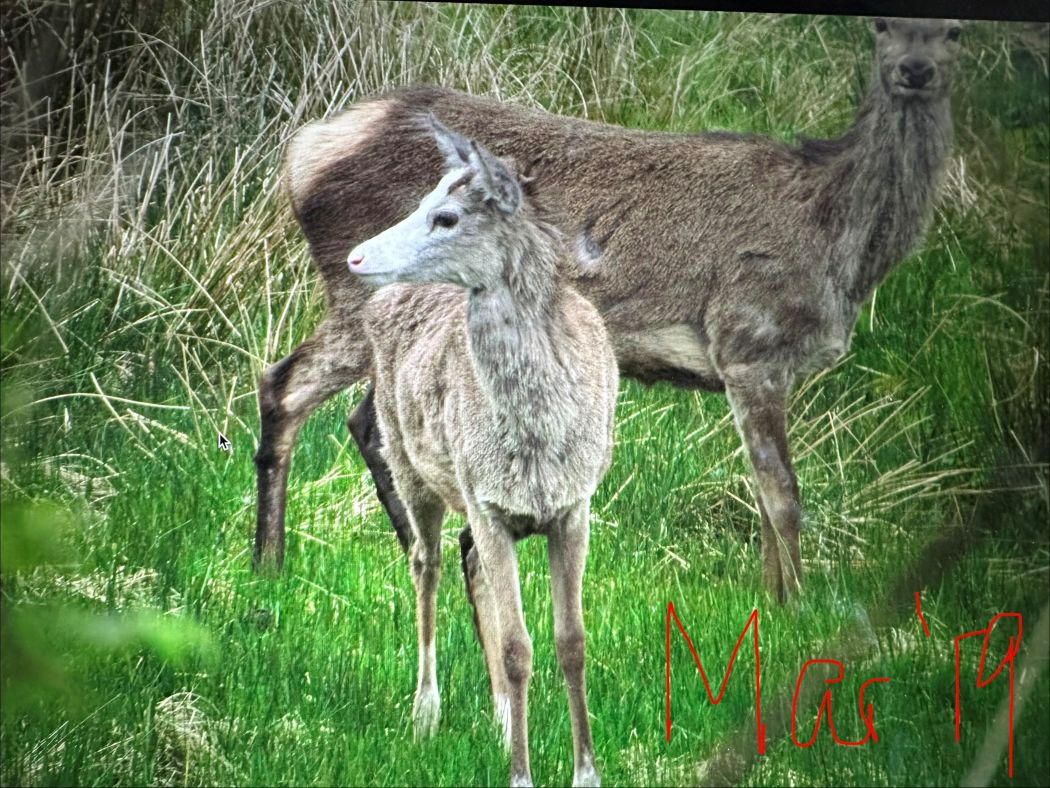
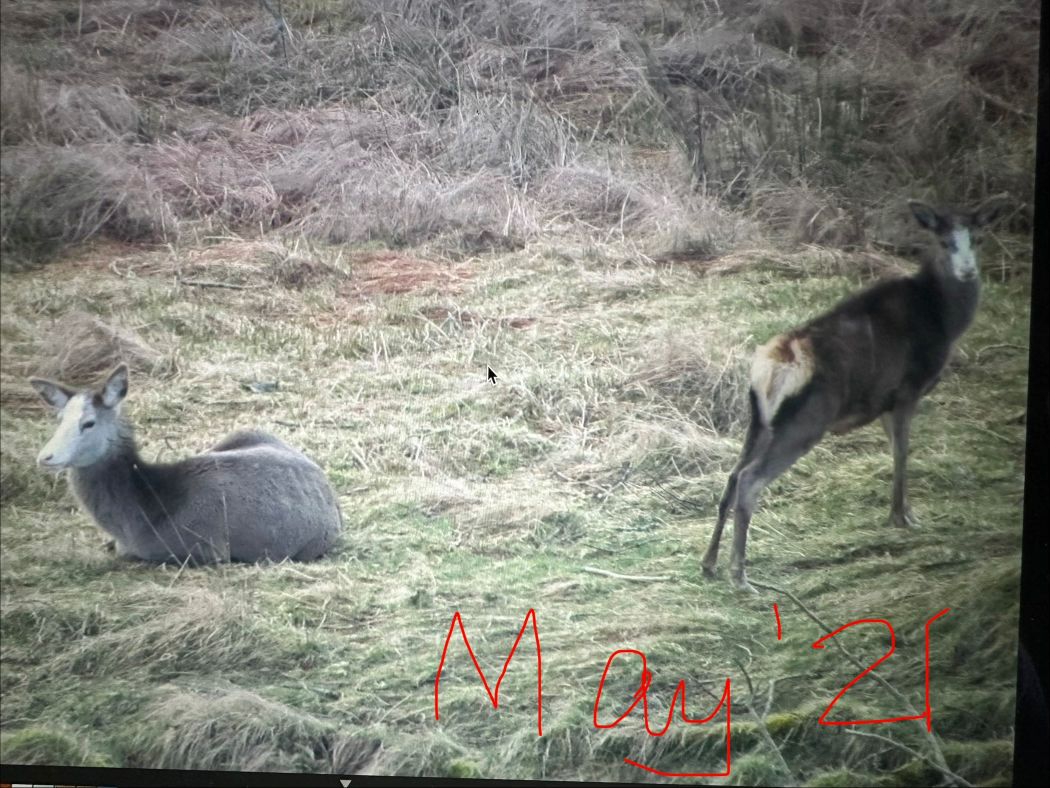
A group of eleven deer were caught near Comrie to stock a deer farm, all of which were bald faced deer, perhaps an extended family group. These animals gave rise to further animals, some of which were used to populate deer parks in England again. And so the circle goes on.
The purpose of this article is simply to raise awareness of these animals. They may or may not be important, but they are certainly interesting, and the story around them does have some local cultural significance. You can see the animals from Eekholt on https://youtu.be/-FKcVZDPFbs . This includes footage of some white red deer as well towards the end of the video.
If you have comments to make, records, photos or theories of your own, I would be happy to hear from you by email victor@nativewoods.co.uk.
Thank you to Ben Harrower, Mike Luti who continually brings up the white faced deer at Balquhidder deer group meetings, Walter Mahnert, John Fletcher, Donnie Broad, Alan Sneddon, Hamish Thomson of Woodland Trust Scotland who chaired the Balquhidder meeting, Angus Hogg and the many people who have recently contributed their thoughts to our understanding of bald/ blaze/ white faced red deer in Scotland, England and in Germany. It is these latter animals which sparked the discussion.
Victor Clements is a native woodland and deer advisor working in Highland Perthshire. All of those mentioned in the previous paragraph contributed material and research used in this article.